
.webp)
When parents search laser tag for kids Singapore, they’re rarely just browsing.
They’re usually planning something real — a birthday party, a school celebration, or a family event — and trying to avoid stress on the day itself.
The concern isn’t whether laser tag in Singapore is popular.
It’s whether this laser tag experience will suit their child.
Will the games feel too intense?
Will younger kids keep up?
Will shy players get lost in the chaos?
This guide looks at laser tag Singapore from a parent’s point of view — focusing on how kids experience a laser tag game, how age and structure affect enjoyment, and how to choose a setup that actually works for children.
A Practical Snapshot Before You Decide
From running kids’ laser tag events across Singapore, here’s what consistently matters more than branding or hype:
- Laser tag is a non-contact activity — most issues come from poor facilitation
- Age suitability depends on how the game is run, not the gear alone
- Short, guided rounds work better than long free-play formats
- Team-based formats help shy players settle in
- Two sessions using identical laser tag equipment can feel completely different
Parents often compare providers like dux laser tag, fox laser tag Singapore, laser quest, or even fun empire laser tag, but the deciding factor is rarely the name.
It’s the structure.
What Laser Tag Feels Like for a Child (Not an Adult)
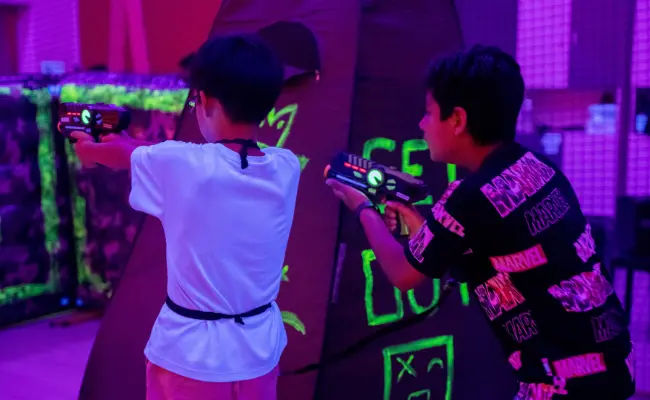
Many adults still associate laser tag with combat skirmish laser tag or high-intensity laser tag battlefield scenarios.
For kids, well-run sessions feel very different.
Laser tag is a game that uses infrared signaling devices — similar to TV remotes. Each player wears sensors and uses laser tag guns (sometimes casually called laser guns) to register hits electronically. There are no projectiles, no physical impact, and no tackling.
What defines the experience for a child isn’t the tech — it’s:
- How clearly the rules are explained
- Whether movement is controlled
- How objectives are framed
- How facilitators guide behaviour
In good kids’ sessions, playing laser tag feels more like a guided mission than a free-for-all.
Is Laser Tag Safe for Kids?
Why laser tag is considered low risk
Because it’s non-contact, laser tag risks are usually behavioural, not physical. There’s no assault rifle recoil, no physical collisions, and no force involved.
Whether it’s indoor laser tag, outdoor laser tag, or mobile formats that bring the game to a venue, safety issues usually arise from:
- Overexcitement
- Poor boundary control
- Lack of supervision between rounds
What makes laser tag safe in real sessions
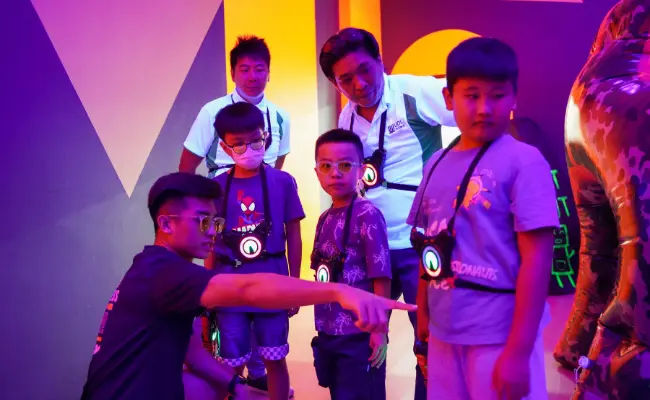
For children, safety improves dramatically when sessions include:
- Clear no-contact rules
- Defined zones (sometimes marked by cones or the cage layout)
- Active facilitators watching behaviour, not just scores
- Built-in breaks between rounds
With proper pacing, laser tag gaming stays energetic without tipping into chaos.
What Age Is Suitable for Laser Tag?
There’s no universal minimum age — suitability depends on design.
Younger children
Laser tag works best when:
- Rounds are short
- Objectives are simple
- Emphasis is on being part of a tag team, not individual scoring
Younger players enjoy the laser tag experience more when they feel included, not eliminated early.
Primary school age
.webp)
This is the most common group for laser tag birthday parties.
Children here usually handle:
- Team objectives
- Simple scoring
- Multiple short rounds
Structured sessions consistently outperform “just run and shoot” formats.
Older kids and teens
Older players can manage:
- Strategy-based missions
- Objective control
- Scenario rounds
Even then, balancing teams matters — especially in mixed-ability groups. Good facilitation keeps sessions fun for anyone, not just the fastest runners.
How Laser Tag Games Are Adapted for Kids
Kids’ sessions should never feel like adult combat scaled down.
Clear objectives
Each laser tag game focuses on one or two goals so every player knows what to do.
Short rounds with resets
Short rounds reduce fatigue and confusion. Resets allow facilitators to re-brief rules and manage excitement.
Active team balancing
Facilitators adjust teams based on age, confidence, and energy level — especially for mixed groups or laser tag birthday events with siblings.
Common Parent Questions Answered
Will laser tag make kids aggressive?
In structured formats, no.
Aggression usually appears only in poorly run sessions without clear objectives. Well-managed laser tag with teams encourages cooperation instead.
Is laser tag suitable for shy children?
Yes. Laser tag works well for shy kids because:
- They play as part of a team
- There’s no individual spotlight
- Engagement feels natural
Confidence often grows after the first round.
Indoor vs Outdoor vs Mobile Laser Tag
Parents often ask which format is best.
- Indoor laser tag offers controlled lighting and sound
- Outdoor laser tag provides more space but needs stricter boundaries
- Mobile formats allow you to play anywhere, from community halls to private venues
For a birthday party, mobile setups work well when space planning and facilitation are clear — whether in Bukit Batok, school halls, or function rooms.
Why Facilitation Matters More Than Gear
Laser tag doesn’t run itself.
Across kids’ laser tag events, the difference between smooth and stressful sessions comes down to facilitation. Trained facilitators manage:
- Safety briefings kids understand
- Pacing and rotation
- Behaviour during excitement peaks
- Team adjustments on the fly
This applies to kids’ parties, schools, and even team building sessions with families.
How Kids’ Sessions Are Run at Laser Tag SG
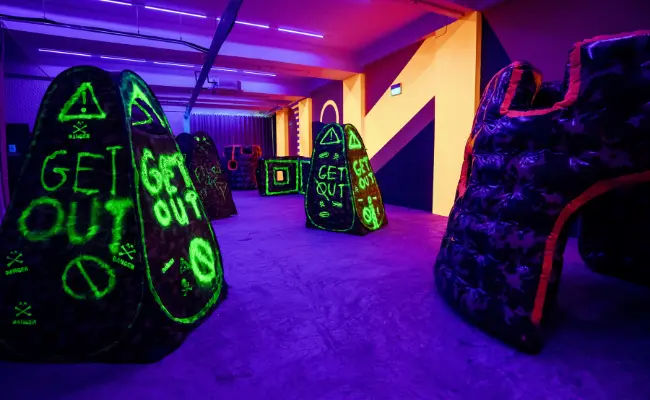
Our approach avoids free-play formats for children.
Our laser tag sessions focus on:
- Non-contact rules only
- Age-appropriate game modes
- Clear briefings before every round
- Active facilitation throughout
Whether it’s a laser tag package for a school, a laser tag birthday, or family-inclusive team building, structure comes first.
Parents comparing options like go laser package, go team formats, or other providers are usually looking for reliability, not intensity.
What Parents Should Look For Before Booking
When choosing a provider, focus on:
- Accessibility for first-time players
- Scalability for group size
- Variety in pacing
- Clear transitions
- Inclusivity across confidence levels
These matter more than flashy laser tag guns alone.
Final Thoughts for Parents
Laser tag can be a safe, engaging activity for children when it’s designed around how kids behave — not how adults compete.
When structured well, the laser tag experience helps children practise communication, teamwork, and early leadership skills naturally.
Understanding how sessions are run helps parents plan with confidence and enjoy the day instead of managing problems.
FAQs: Laser Tag for Kids Singapore
Is laser tag safe for kids?
Yes. Laser tag is safe when supervised and non-contact. Safety depends more on structure than equipment.
What age can kids start playing laser tag?
There’s no fixed age. Comfort level and game design matter more.
Can kids play laser tag indoors or outdoors?
Yes. Indoor, outdoor, and mobile setups all work when rules and boundaries are clear.
Is laser tag suitable for mixed-age groups?
Yes. With proper pacing and team balancing, mixed groups work well.
Is there value beyond fun?
Yes. Structured laser tag encourages teamwork, communication, and problem-solving in an engaging way.
Can laser tag be adjusted for different group sizes or venues?
Yes, with proper setup and facilitation, laser tag can be adjusted to suit different group sizes and run safely indoors, outdoors, or as a mobile experience that brings the game to your chosen venue.